
 Message us
Can Vitamin K2 Actually Dissolve Calcium in Your Heart Arteries?
Patients frequently come into my clinic showing me videos claiming that Vitamin K2 pulls calcium out of your arteries and sends it off to your bones instead. Someone with a calcium score of 450 will ask me whether they should skip their statin and just take K2. I get some version of this question constantly these days. The idea has spread everywhere on YouTube and Instagram, and honestly, it's an appealing story: calcium belongs in bones, not blood vessels, so why not just redirect it?
Biology rarely cooperates with stories that neat. Fortunately, we finally have solid data to work with. The DANCODE trial, published in Circulation in August 2026, gives us something concrete to evaluate, and the results are interesting, though more limited than a lot of the online commentary suggests.
What a calcium score is actually measuring
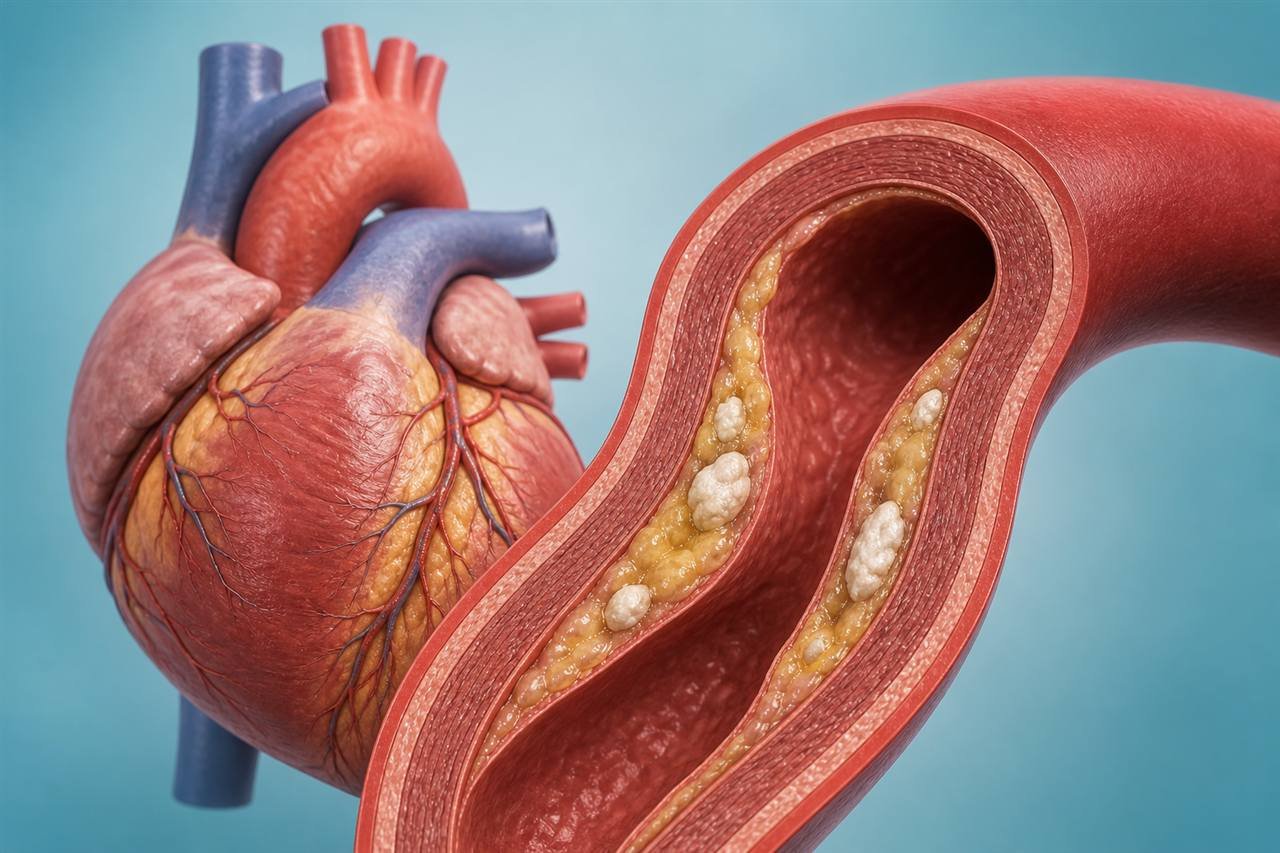
First, some context most people never get from their doctor in a ten-minute visit. The calcium sitting in your coronary arteries isn't loose dietary calcium that wandered into the wrong place. It's the end stage of a process that's been running for decades, as LDL and other apoB-containing particles work their way into the artery wall, the immune system reacts, plaque builds up, and eventually parts of that plaque calcify.
So the calcium score is mainly telling us about the burden of atherosclerosis that has accumulated over your lifetime. Heart attacks usually happen when an unstable plaque ruptures or erodes and triggers a clot, not because the calcium itself suddenly blocks the artery. Focusing purely on “removing the calcium” misunderstands what's actually dangerous here.

Why K2 was ever a plausible idea
There's real biochemistry behind this idea, which is part of why it's stuck around. Vascular smooth muscle cells produce a protein called Matrix Gla Protein, one of the body's natural inhibitors of vascular calcification, and Vitamin K is needed to activate it. That led to a reasonable question: if we give Vitamin K2, particularly the long-chain form MK-7, can we activate more MGP and slow calcium deposition in arteries?
Plenty of treatments that look promising on this kind of mechanistic logic still fail once they're tested in actual humans, which is exactly why a trial like DANCODE mattered.
What the trial found
The Danish Coronary Decalcification trial enrolled 398 people with significant existing coronary calcification, median age 71. Everyone entered with an Agatston score of at least 400, and the median was around 900. Half received high-dose Vitamin K2 (720 µg of MK-7 daily) together with Vitamin D3; the other half received placebo.
After two years, calcium scores had gone up in both groups, so nobody walked away with cleaner arteries. But progression was slower in the K2/D3 group: an increase of 196 Agatston units on average, compared with 248 units in the placebo group. That 52-unit difference (95% CI, −79 to −24) works out to roughly 21% less progression over two years. A CT angiography sub-study in 143 of the participants also checked whether slowing calcification might backfire by leaving behind more unstable, non-calcified plaque, and it didn't find that.
What it didn't show
It's worth being just as clear about the limits. Nobody's calcium score went down, and progression slowed rather than reversed. Nothing was shown to have been dissolved or moved from the arteries into the bones; that's simply not what happened in the trial.
There are other limitations too: DANCODE tested high-dose K2 alongside D3, not K2 alone, so we can't assume a low-dose supplement would do the same thing. And the participants were older adults who already had severe calcification, so we don't yet know whether any of this applies to, say, a 45-year-old with a calcium score of 30 or 50.
Does any of this prevent heart attacks?
That's the question that actually matters to patients, and to me in the cath lab: does it lower the risk of a heart attack or stroke, keep someone off a stent or off the operating table, extend life? DANCODE wasn't designed to answer that. It was powered to detect changes in coronary calcium, not clinical cardiovascular events.
A slower rate of calcium buildup is a genuinely interesting imaging finding, but it isn't the same thing as proof that fewer people will have heart attacks. For that we'd need a properly powered outcomes trial, and we don't have one yet.
What I'd actually tell a patient
Don't drop your statin for this. Statins and other established LDL-lowering therapies, including PCSK9 inhibitors where appropriate, have decades of clinical outcome data behind them. Statins can sometimes increase the density of calcium within plaques while making those plaques more stable, so seeing more coronary calcium during statin treatment doesn't automatically mean the disease has gotten worse. Trading a proven therapy for a supplement on the strength of one imaging trial would be a bad bet.
If you're on Warfarin, don't start Vitamin K2 on your own. Vitamin K can interfere with how a Vitamin K antagonist works and destabilize your INR, so any change to your Vitamin K intake needs to go through the doctor managing your anticoagulation.

And if your calcium score comes back high, the real work isn't chasing the mineral. It's getting your LDL and ApoB down, controlling blood pressure and diabetes, quitting smoking if you smoke, staying active, and managing your weight. That's where we already have strong evidence that treatment changes outcomes.
Bottom line
DANCODE was a well-conducted, randomized, placebo-controlled trial, and the difference in calcium progression it found was real and measurable. That's worth taking seriously. But it would be a mistake to leap from “slower progression” to recommending Vitamin K2 routinely for anyone with coronary calcium.
We still don't know whether slowing CAC progression actually translates into fewer heart attacks, strokes, or cardiovascular deaths, and until we do, I wouldn't treat Vitamin K2 as a replacement for established cardiovascular prevention. If you have a high calcium score, the priority isn't trying to dissolve the calcium; it's treating the underlying atherosclerotic disease and the risk factors driving it, because that's where the evidence for changing outcomes already exists.
If you have a high calcium score and want it reviewed in Hyderabad, bring the CT report to a cardiologist. At Pulse Heart Super Speciality Hospital, Miyapur, we assess calcium scores as part of full cardiac risk care. Appointments: +91 8886688063. Emergency: +91 9000777019.
Frequently asked questions
Did DANCODE show that Vitamin K2 dissolves artery calcium?
No. Calcium scores went up in both groups. High-dose K2 with D3 slowed progression by about 21% over two years. Nothing was dissolved or moved into the bones.
Can I skip my statin and take Vitamin K2 instead?
No. Statins and other proven LDL-lowering treatments have decades of outcome data. Trading them for a supplement based on one imaging trial is a bad bet.
Is Vitamin K2 safe if I take warfarin?
Do not start Vitamin K2 on your own if you take warfarin. Vitamin K can change INR. Any change must go through the doctor managing your anticoagulation.
What should I do if my calcium score is high?
Treat the atherosclerosis and risk factors: LDL/ApoB, blood pressure, diabetes, smoking, activity and weight. Discuss your CT report with a cardiologist at Pulse Heart, Miyapur, or use the appointment form.
Reference: Hasific S, et al. “Vitamin K2 and D3 Supplementation in Patients With Severe Coronary Artery Calcification: The DANCODE Trial.” Circulation. Published August 28, 2026. DOI: 10.1161/CIRCULATIONAHA.126.082363.
— Dr. M. S. S. Mukharjee
Senior Interventional Cardiologist
Pulse Heart Super Speciality Hospital, Miyapur, Hyderabad
This article is for educational purposes only and isn't a substitute for individualized medical advice. Talk to your own physician before starting, stopping, or changing any medication or supplement.