
 Message us

Very High Calcium Score: Are Blocks Certain?
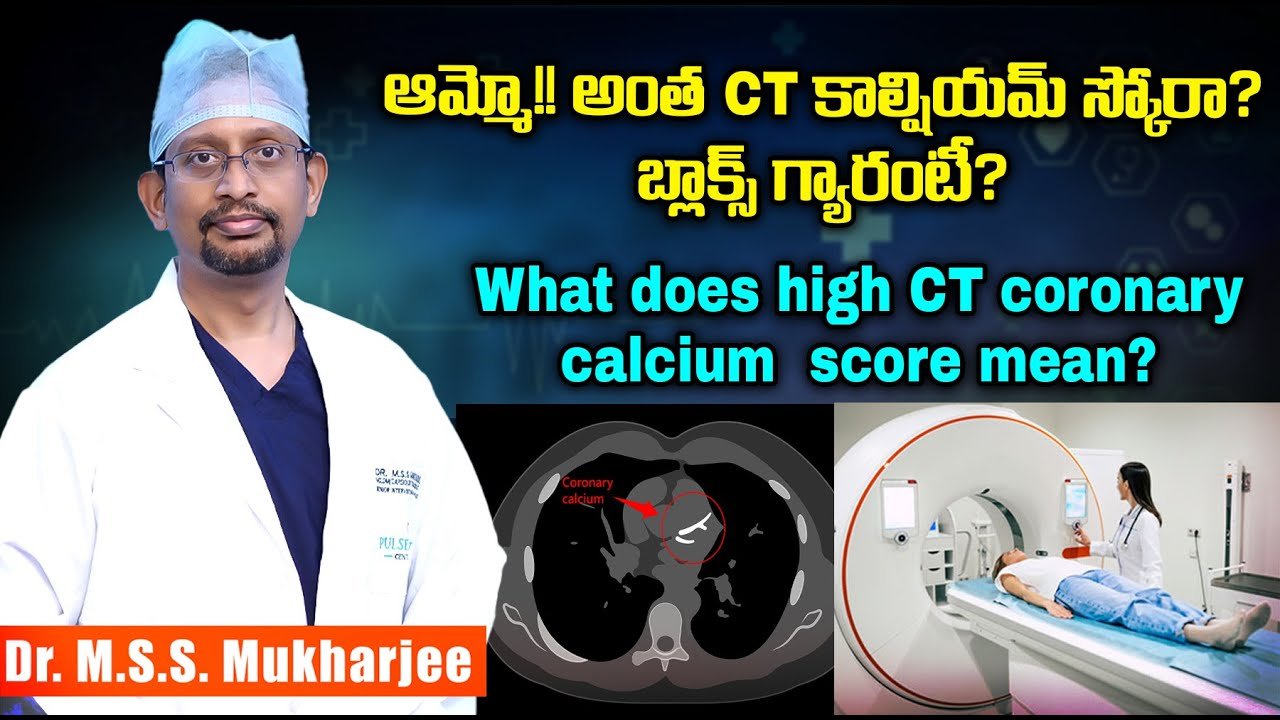
Today we are talking about a very unusual patient, someone very close to me. While talking about him, let us try to learn some important information. It was a scary situation, and if you understand how we tackled it, you will understand this whole subject.
Subba Rao garu's story
I am calling him Subba Rao garu, with his name a little changed. He is 84 years old. At 84, he had some atypical pain, occasionally like a pricking, and a little breathlessness when walking. On someone's advice he got a CT calcium score done. When they saw the values, they panicked immediately. They did not believe the score could be that high, so they got it done in another lab too. What came, why they panicked so much, and what happened next is what we will talk about today.
This calcium score was done on 2 March, and this one on 4 April, a repeat. On 2 March he brought me the calcium scoring report. How much should the CT coronary calcium score normally be? Zero. His was 2,827. Notice how high: it should be zero, and it was 2,827.
Then the thought came to repeat it, and I repeated it. The important thing here is that it got delayed by a month, but I reassured him: just because it is this high, there is no need to fear, because the pain and breathlessness he described did not seem heart-related. So they took some time, and a month later the calcium score came to 3,133. Even higher.
Lesson 1: the number varies from lab to lab
If the calcium score is high, it may not come the same when done in two or three labs. Zero may come the same in all of them, but when there is a calcium score, the number depends on what software is used, how it is calibrated, and how many section cuts are taken. So after a calcium test in one lab, if another lab shows more or less, there is no need to fear. This was done only as a test.
Actually, once a CT coronary calcium score is above zero, repeating it is of no great use. His score did not rise from 2,800 to 3,133 in one month; the same calcium was interpreted with different software and different calibration levels. So there is no need to get calcium scores done serially.
How calcium scores are graded
- Normally it should be zero.
- 1 to 100: consider it mild risk.
- 100 to 300, some say 400: moderate cardiac risk.
- Above 400: high risk.
If 400 is high risk, he had about 3,000, so he is definitely in high risk. But one important thing: as age increases, calcium can come, and it can come in large amounts too.
So what to do when calcium is this high? Panic? There is no need to panic. If there are some symptoms, it is enough to do an angiogram once. If the angiogram shows blocks, we should take treatment for them. Normally, as calcium increases, the chance of blocks increases. That is why people fear a high calcium score.
What his angiogram showed
This is his angiogram. This is the right coronary artery, the RCA, the blood vessel on the right side of the heart. If you look, it is smooth like this, except here it is a little narrow, and here a little narrow, but overall it is flowing wonderfully. There are no critical blocks anywhere; maybe 10% or 20% blocks here.
Here we are looking at another angle. This is the left-side blood vessel. Here too it is clean, a little narrow here and there, mostly normal. Looking at the left side from another angle, the vessel coming from below, the left circumflex artery, shows some mild block proximally. A block does not mean it looks black; a block means it is narrow, and here it looks a little narrow. That is overall what he has, seen in multiple angles.
If I have blood vessels like this at 84, I will be very happy. Subba Rao garu is very well. After the angiogram, what we told him is: however much calcium there is, the flow in the blood vessels is good, so there is no need for him to fear about his heart in any situation, and he can be happy.
So we need to know there is no need to panic when calcium is high. Until now you may have often seen mild disease or normal results with calcium of 100 or 200. I wanted to show this to say that even when the calcium score is above 3,000, there is no need to fear. That is why I presented Subba Rao garu to you.
Lesson 2: calcium does not greatly raise heart attack risk
Having more calcium does not greatly increase the chance of a heart attack. In fact, comparing a calcified block with a non-calcified block, the block without calcium is more likely to rupture and thereby cause a heart attack. With a heavily calcified block there may be pain when walking, but such blocks rupture less.
That is why calcium levels rise in some people when statins are used. Even if it rises, the plaque gets stabilised, so heart attack risk is lower. In fact, when calcium is high, we ask for even more cholesterol medicine, not to reduce calcium, but to reduce the block inside, or if it does not reduce, to stabilise it. That is why we use statins. This must be clearly understood.
Lesson 3: zero calcium can still have blocks
We must also know the converse. Just as Subba Rao garu shows that blocks may not be there with very high calcium, in some people significant problems can be there even with zero calcium. In fact, they say one in six people with zero calcium can have blocks.
How do we know? When we look at three things together: non-invasive testing, symptoms and risk factors. If there is pain when walking, or many risk factors, or a positive non-invasive treadmill test, we should investigate further even if the calcium score is zero. So one, symptoms; two, non-invasive testing; three, risk factors. When at least two of these three point towards heart disease, we should go further regardless of the calcium score.
So with a very high calcium score, blocks may be there but need not be. Similarly, with a zero calcium score, blocks need not be absent.
So why do a calcium score?
It is very useful in some people. For example, there are some risk factors, symptoms are not typical, and the treadmill test is mildly positive, neither here nor there. If the calcium score is zero, it gives us a lot of confidence; a zero calcium score can be taken like a negative treadmill. Just as a positive treadmill does not mean blocks must be there, and a negative one does not mean they must be absent, the CT calcium score should also be used for risk stratification. It is not correct to fear because the score is high, or to relax completely because it is very low.
We learned that very high calcium comes with age. Similarly, after bypass surgery calcium is very high in the blood vessels. We need to remember that.
Before you get a calcium score
If you are getting a calcium score, first discuss with your cardiologist why you are getting it and, depending on the value, how you should take treatment. Otherwise we will panic a lot. Some people, after getting calcium of 400 or 500, read below in the report that above 400 is very high, severe risk, and get frightened.
So first know your pre-test probability and then get tested. For any test, if we think about what to do with each result, talk to the cardiologist and get that clarity before doing it, the chance of panic is low. That is Subba Rao garu's story.
In his words: the key point
A very high calcium score does not mean blocks are certain, and a zero score does not mean they are absent. Discuss with your cardiologist before getting the test, so you know what each result means.
Frequently asked questions
What is a normal CT coronary calcium score?
Zero. Dr. Mukharjee explains 1–100 is mild risk, 100–300 (some say 400) moderate, and above 400 high risk.
Does a very high calcium score mean I have blocks?
Not necessarily. His 84-year-old patient had scores of 2,827 and 3,133, yet the angiogram showed no critical blocks.
Why did my score differ between two labs?
Software, calibration and section cuts differ, so the number varies. Once the score is above zero, repeating it serially is of no great use.
If my calcium score is zero, am I safe?
About one in six people with zero calcium can still have blocks. If two of three (symptoms, a positive treadmill test, risk factors) point to heart disease, investigate further.
— Dr. M. S. S. Mukharjee
Senior Interventional Cardiologist
Pulse Heart Super Speciality Hospital, Miyapur, Hyderabad
This article is for educational purposes only and isn't a substitute for individualised medical advice. Talk to your own doctor before starting, stopping or changing any medicine.